
We advance the science of active-solid interfaces for vibrating nanoscale transducers, by utilising Localized Surface Plasmon Resonance (LSPR) and Quartz Crystal Microbalance with Dissipation (QCM-D) platforms to understand and guide interactions with bio/chemical systems. By integrating LSPR and QCM-D with precision nanofabrication, surface chemistry, microfluidics, electrochemistry, and live-cell assays, our team uncovers how prokaryotic and eukaryotic cells, proteins, and nucleic acids interact with and respond to dynamic nanosolids. Key research areas include:
- Plasmonic transduction of bio/chemical recognition events via LSPR
- QCM-D characterisation of bio/chemical interfacial assemblies
- Surface functionalisation & biointerface engineering
Video Highlights
Nanocube technology: Pocket-size
spectrophotometer and instrumentation for LSPR
spectrophotometer and instrumentation for LSPR
Lab-grown locusts interacting with
magneto-plasmonic nanoparticles
magneto-plasmonic nanoparticles
LSPR-driven nanophotonic self assembly
of micron size particles
of micron size particles
Field-enhanced single cell trapping and rotation in microfluidic sensing systems
Audio Highlights
🔊 Acoustic Fingerprint of Pantoea sp. YR343
🔊 Acoustic Fingerprint of Mutated Pantoea sp. YR343 Signature
Visual Highlights
Latest News
Combined theoretical-experimental work on measurement of picoNewton biomolecular forces using simple UV-Vis spectrophotometer published in Advanced Physics Research
•
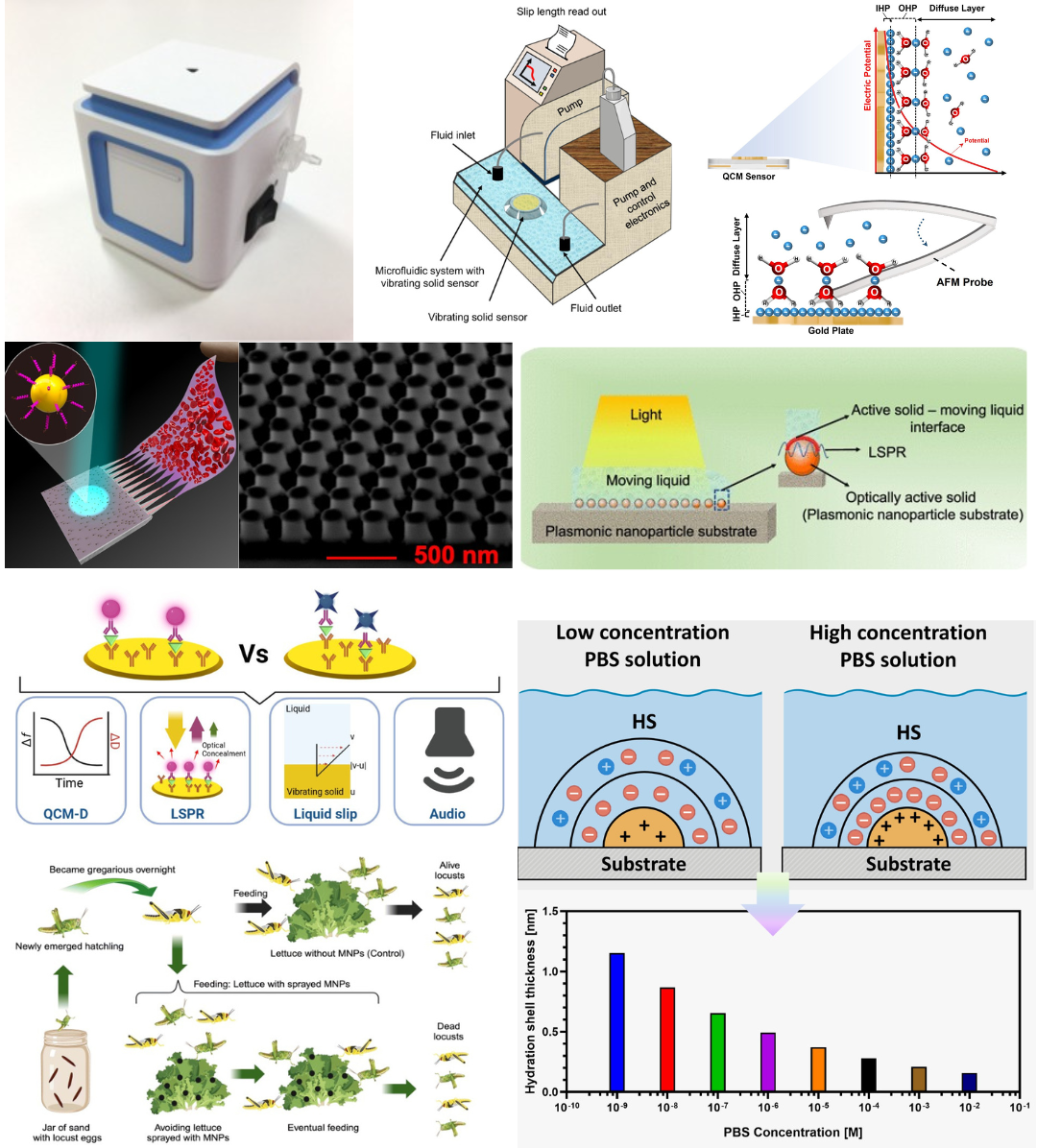
New work on resolving nanoslip, solvation inertia and charge dynamics at vibrating solid-liquid interface published in Small
•
In our recent study published in Advanced Functional Materials, we uncovered how changes in ionic strength cause the thin layers of water surrounding nanoparticles to shrink.
•